Tuesday, March 25, 2014
In the US for a while now!
Now that I'm stateside for a while, I won't be gallivanting in the Holyland (obviously). You can read about Emet and me over at Two Frum Queers! Hope to see you there!

Sunday, March 9, 2014
Side trip to Greece
Near the beginning of my journey in Israel, I spent some time in Greece. Things are coming full circle because Emet and I just got back to Israel after a short vacation in Greece last week.
It was nothing like the last time I was there...in September 2012, it was sunny and gorgeous and exciting. This time, it was rainy, cold, miserable, and not really a vacation. Emet and I made the best of it, though we wished we had gone to Eilat instead for the week, where it would have been sunny and warm. 


We started in Thessaloniki, where we had hoped to find the Jewish community. It seemed by reviews online that there was a lot to do and see there, but we actually did it all in one day. On Shabbat, we tried to find services, but failed to do so. We found the synagogue but it was locked.
There was another synagogue and we walked up and down the street trying to find it, but also failed at that. So we went to the museums because it was raining. On Sunday, we found the Jewish museum, which was just depressing. Essentially, the Jewish community in Thessaloniki used to be quite large, but the Nazis shipped a majority of them out to camps and they never returned. The community now is difficult to find, if there really is one. We weren't sure if they even had a minyan for services on Shabbat.
On Sunday afternoon, we traveled to Athens, where it was clear skies for the night and then pouring rain for the next two days. We stayed in the hostel or went to a coffee shop to ride out the rain.
On our last two days, it was finally sunny, and we saw all the ruins you can see on the ticket for the Acroplis.
We walked a lot that day, and saw a lot, even though it wasn't very interesting. All the ruins started to look the same after a while.
On our last day, we walked up Mount Lycabettus, which showed a nice view of the city. We were ready to come home, though, and made our way to the airport.
We learned that we travel well together and tend to balance each other out. When I was upset by the disappointment of the trip, Emet supported me, and when she was reaching her point of disappointment, I supported her. Overall, it was not really a vacation, but it was great for us to connect in a new place and spend some time together. Our last week at school had really been too busy for us to spend qualitative ime together.
Tuesday, February 25, 2014
Pekudei and Time to Go Forward
By Emet
In this week's parsha, Pekudei, Moshe and the Israelites are continuing to work hard to complete the Mishkan according to Gd's specifications. At the end of the parsha, the very last chapter of the book of Shemot, the excitement of the completion is palpable:
You can only imagine this moment of awe, wonder, and joy after the people's coming together as one to build a dwelling for Gd. They are leaving the place they had settled and become accustomed to. They are finally ready to continue forth into the desert, with their trust in Gd and Moshe. They know that whatever they happen upon, they are prepared for it.
Right now, the cloud in our life is rising, letting us know that it's time for us to travel on our way, to continue on our journey. It's been an honor and a privilege to be a part of building a space with everyone at Pardes, where we are all striving to know Gd, each in our way.
Just as Moshe blessed the people after the completion of the work in the parsha, may we bless everyone that when you recognize that the cloud in your life is rising, may you be just as full of excitement, joy, wonder, and gratitude as we are right now.
Friday, February 7, 2014
Putting on Tefillin for the First Time
There has been a lot of hype around women wearing tefillin lately (see here, here, here, and here). Since I just started taking the "Women and Mitzvot" class, this is a topic that I have followed. I've also been intrigued by the whole idea of tefillin for a while now.
For most of my life, I saw tefillin as something that Orthodox men do. It was never part of my life, nor did I ever see anyone wearing it. I just knew that they were boxes that Orthodox men wore when they prayed. This year, I saw other women wearing tefillin, both at Women of the Wall and in the Pardes minyanim. My curiosity peaked. What was special about tefillin? Did it really change the way one prayed? Does it make the person feel more focused during prayer?
When I was 13 and becoming a bat mitzvah, I received my first (and only) tallit, but I haven't worn it since. Whenever I have prayed, it is just me, nothing else. But I started thinking about how wearing tallit or tefillin could make that prayer space special and separate it out from the rest of the day.
I decided early in the year that I wanted to try tefillin. To see what it felt like and how it might affect the way I relate to prayer. This week, I got that chance. My friend Sam who blogs here graciously showed me how to put on tefillin.

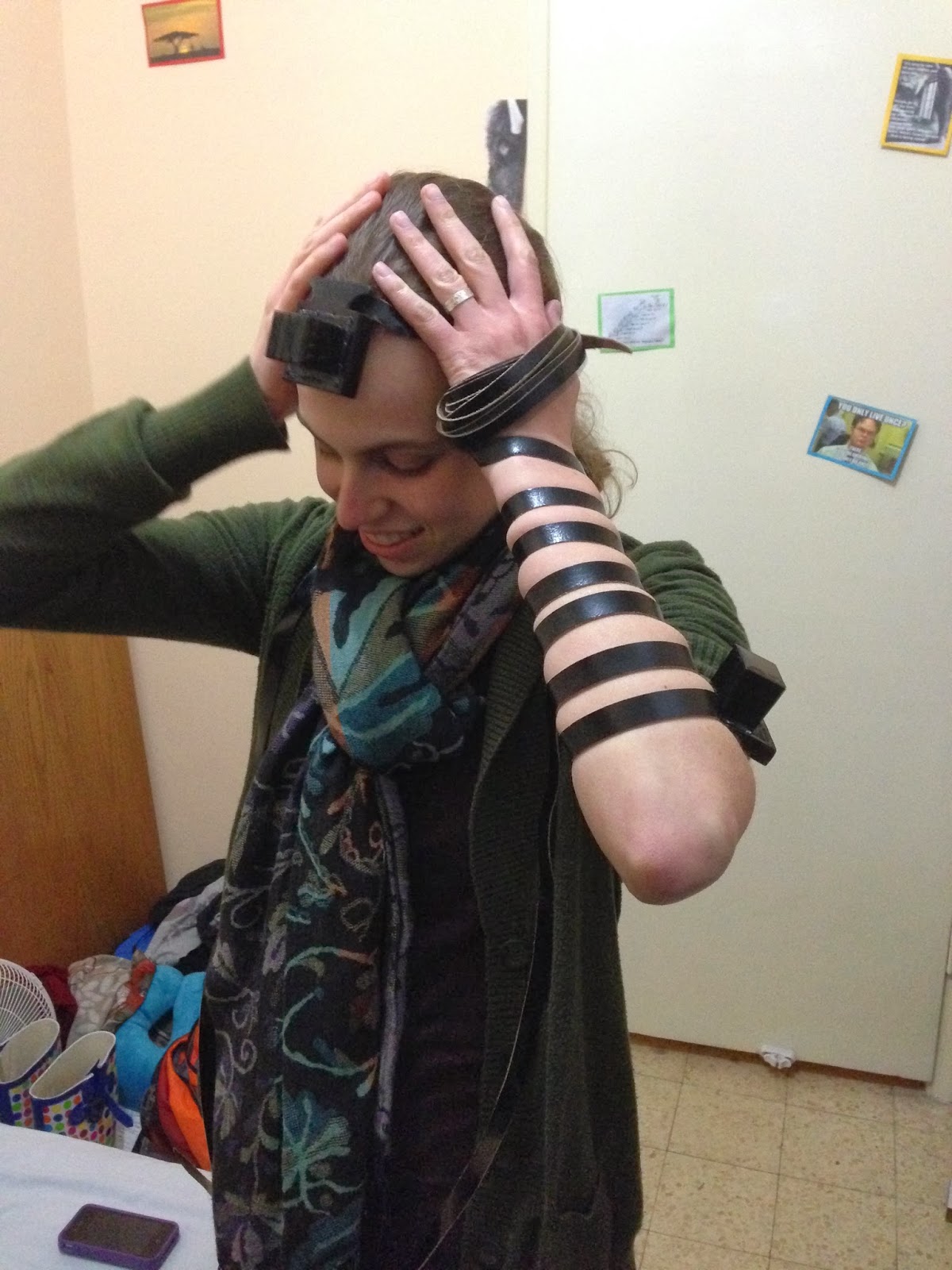
I felt like I was doing something that had been forbidden - like getting a cookie out of the cookie jar in the middle of the night. I can't tell you all my feelings about putting on the tefillin, only that it was really cool. I felt like I was connecting with the past and the future. I felt like part of the Jews. Not that I don't feel that on any other day - I do, but this was different.
Because I didn't actually pray with them on, I don't think I got the real feeling of wearing tefillin. I'm looking forward to the next time I could try praying with tefillin. I wonder if that will affect the way I pray or how I feel connected to prayer. When I get my tallit from my parents' house, I want to start praying with that, too, so that I will especially mark out the time in prayer as different. I think creating a special prayer space will enhance my prayer so much more. Shabbat shalom!
For most of my life, I saw tefillin as something that Orthodox men do. It was never part of my life, nor did I ever see anyone wearing it. I just knew that they were boxes that Orthodox men wore when they prayed. This year, I saw other women wearing tefillin, both at Women of the Wall and in the Pardes minyanim. My curiosity peaked. What was special about tefillin? Did it really change the way one prayed? Does it make the person feel more focused during prayer?
When I was 13 and becoming a bat mitzvah, I received my first (and only) tallit, but I haven't worn it since. Whenever I have prayed, it is just me, nothing else. But I started thinking about how wearing tallit or tefillin could make that prayer space special and separate it out from the rest of the day.
I decided early in the year that I wanted to try tefillin. To see what it felt like and how it might affect the way I relate to prayer. This week, I got that chance. My friend Sam who blogs here graciously showed me how to put on tefillin.
I felt like I was doing something that had been forbidden - like getting a cookie out of the cookie jar in the middle of the night. I can't tell you all my feelings about putting on the tefillin, only that it was really cool. I felt like I was connecting with the past and the future. I felt like part of the Jews. Not that I don't feel that on any other day - I do, but this was different.
Because I didn't actually pray with them on, I don't think I got the real feeling of wearing tefillin. I'm looking forward to the next time I could try praying with tefillin. I wonder if that will affect the way I pray or how I feel connected to prayer. When I get my tallit from my parents' house, I want to start praying with that, too, so that I will especially mark out the time in prayer as different. I think creating a special prayer space will enhance my prayer so much more. Shabbat shalom!
Tuesday, February 4, 2014
Shabbat: New Experiences and Emotions
Since I've been keeping Shabbat, I have had some that are absolutely fabulous and some that aren't as much. It depends on whom I'm with, mainly. This past Shabbat was so amazing; I can only attempt to explain it.
On Friday night, Emet and I went to a Reform shul. I haven't gone to a reform service since 2012, and so it noticeably is different from what I've been used to. There was just the right amount of silent meditation, and even though we didn't sing all the songs in Kabbalat Shabbat, there was a great deal of beautiful songs. As we got to the evening Amidah, I at first started reciting what I usually know, but when my words didn't go along with what was on the page of the book, I stopped and restarted with what was on the page. I was pleasantly surprised that the text had inserted references to Sarah, Rebecca, Rachel, and Leah, in addition to Abraham, Isaac, and Jacob. I recognize the lack of our mothers in the usual Amidah that I recite, and whenever possible, I include them in the blessing after meals. Even so, I was overjoyed by their inclusion that it instantly affected the way I related to the Amidah that night. We continued praying and there was a lot of lovely singing. The shul we typically go to on Friday nights has been inadequate lately with the singing, and so it made me feel good when the singing was both beautiful and generally On (key, tempo, and together).
After shul, we walked to dinner, where we had been invited last minute. At the table, the queers outweighed the straights, and we had engaging conversations talking about all sorts of things. There were a few new people at the table, and it was interesting to listen to new stories.
In the morning, we went to Shira Chadasha, where Emet received her first aliyah to the Torah. I had forgotten that it was Rosh Chodesh and there was an inserted section called Hallel. This section is added into the morning service on certain holidays and festivals, including Rosh Chodesh. It consists of a number of psalms that have specific tunes, and not only are the tunes lovely, but the meaning of the psalms are very touching. I saw this line: "How can I repay unto Gd all Gd's bountiful dealings toward me?" - and I meditated on all the good fortune I have right now. I'm in a beautiful place, learning, and engaged to be married to my bashert. My family and friends are all in good health, and I'm so lucky to be here at this very moment. The singing and the meditating on the goodness in my life made me very teary. I was in this space of happiness, and it was so great.
After Hallel, Emet was called to the Torah for her first aliyah. She had practiced a lot with me the week before, and I know she was nervous. A few of our friends came to shul to support her. She did so wonderfully! I was and still am so proud. She sang the blessings perfectly! I know she was very touched by going up to the Torah and was emotional afterward.
This Shabbat seemed to be a culmination of everything lately - learning, love, friendship, and community. I know both Emet and I felt how special it was to have Shabbat here in Jerusalem with the Pardes community, and overall, I just feel that this past Shabbat could not have been better.
Crossposted at Two Frum Queers
Wednesday, January 22, 2014
What I've Learned About Myself Thanks to the Israeli Health System
As a resident of a country whose primary language isn't my own and where the health system is very different, I often have challenges when needing to get things done.
Seeing a doctor that speaks English is so amazing, you have no idea. We completely take it for granted in the US when our doctor speaks the same language as us. Not only that, but having to listen to phone systems in a different language and understanding what number to press can be very difficult. I love that I don't have to pay for things (taxes do) but it is so frustrating having to take one paper from the doctor to the central health insurance office and then getting another paper to bring to a lab to get a test. At all of these offices, you take a number and sit and wait for a while. Keep your patience but be assertive. It's ok to be pushy but not enough to frustrate the person who will serve you. Also, you have to be patient while the clerk chats with a coworker, looks at someone else's chart, makes a phone call, ANSWERS THEIR OWN PERSONAL CELL PHONE, or just is going pretty slowly. You, as a customer, are obviously second to their own priorities. Offices aren't open every day, all day, and it's your own fault if you don't know which days they are open. It's not the problem of the clerk if you can't come on the day that they are open.
It is nothing like that in the US. I will gladly wait a little longer or pay a little more to have GOOD customer service, to have to go to only ONE office to get something done, where things actually arrive in the post when they are supposed to, and you don't have to worry about figuring out which office you have to go to next, what words you need to know in order to get your point across, and if you will be helped.
Even so, I have learned to pay attention here. If you for just one minute walk away or get on the cell phone, you will lose your turn (or anger everyone else while you "cut" in line since you missed when your number was called). I have learned to be aggressive when I need to, even if I can't speak the language. I have learned to ask questions and explain things that you would be asked in the US, though it isn't always part of the standard things to discuss here - allergies for example when you are prescribed medication. I have also learned that doctors here openly acknowledge that they don't know everything and THAT'S A GOOD THING.
Monday, January 20, 2014
Kiddushin and the Queers
This week, a classmate of mine at Pardes wrote a blog post about Kiddushin, being a gay man, and how he might see this tradition actualized in his own future relationship.
I am a queer observant woman who is getting married to another queer observant woman, and my partner and I have discussed how to balance our queerness and halacha to some extent (there is a lot more to discuss) and in particular how we plan to bring Jewish tradition and halacha into our wedding.
Our beliefs and practices are informed by Orthodox Judaism, and it is important for Emet and I to have a traditional Jewish wedding as much as possible because we recognize the importance of tradition. That being said, we know that under Jewish law, our marriage will not be valid. So, we are having many discussions about which Jewish traditions we find appropriate and relevant to us and which ones we need to alter or eliminate all together.
Traditions of a Jewish Wedding Ceremony:
I am a queer observant woman who is getting married to another queer observant woman, and my partner and I have discussed how to balance our queerness and halacha to some extent (there is a lot more to discuss) and in particular how we plan to bring Jewish tradition and halacha into our wedding.
Our beliefs and practices are informed by Orthodox Judaism, and it is important for Emet and I to have a traditional Jewish wedding as much as possible because we recognize the importance of tradition. That being said, we know that under Jewish law, our marriage will not be valid. So, we are having many discussions about which Jewish traditions we find appropriate and relevant to us and which ones we need to alter or eliminate all together.
 |
| Copyright White Rose Kallah |
- The couple does not see each other for a week prior to the wedding.
- The bride and groom go to the mikveh in order to enter into their marriage spiritually clean.
- Both the bride and the groom have separate rooms for guests to greet them prior to the wedding (kabbalat panim).
- The ketubah is signed by two Shabbat-observant men.
- After the kabbalat panim, the groom goes to the bride's room and places a veil on her, called the badeken, to symbolize that he is not solely interested in her physical beauty.
- Under the chuppah (the marriage canopy), there is the betrothal blessing (kiddushin) over wine, when the groom gives the bride a ring, and the nisu'in, when the husband unites with the wife under the chippah through the Sheva Brachot, or Seven Blessings.
- Following the ceremony, the couple goes to the yichud room, where they spend a few minutes together for the first time alone after the ceremony.
How we as a queer couple want to maintain tradition:
- We will not see each other for the week leading up to the wedding.
- We will go to a mikveh.
- While we plan to see each other prior to the Kabbalat Panim, in order to take pictures and to reduce the emotional impact of seeing each other for the first time after a week, we likely will have two separate rooms for the kabbalat panim.
- We are altering the kiddushin and the Sheva Brachot slightly to be more relevant and meaningful to us, though we are maintaining much of the wording.
- We will have the yichud, as well.
- We also have written our own ketubah text based upon traditional and modern texts to reflect our relationship.
What I've learned about Jewish tradition is that while we have customs that are passed down through history, each generation has changed them to be more relevant to their lives. You may not hear this from observant Jews, but even their practices have been informed by the commentators of a generation ago, and it is important for Emet and I, as a queer couple who wants to maintain tradition, to figure out a way to keep important aspects of it present in our wedding ceremony and our life.
There has been much discussion lately about religious GLBT people. Who we are, how we balance religious practice and being queer, and how we relate to each group (religious and GLBT people), as though they are separate identities. I'm very lucky that I can be an active member of both communities and that there are many, many queer Jews out there doing the exact same thing.
Cross-posted at Two Frum Queers, where we are writing about our experiences being Jewish, queer, and getting married.
Cross-posted at Two Frum Queers, where we are writing about our experiences being Jewish, queer, and getting married.
Friday, January 3, 2014
Our NYE's Engagement Party
Our wonderful friends at Pardes threw us a New Year's Eve Engagement Party. We are so blessed to have friends and family who are supportive. I was telling our story to one of my classmates, and she explained how emotionally involved she is in our relationship. Many of our classmates feel very connected to us and our story, and more than one person has told me (and Emet) how they admire our relationship and want to establish a relationship as strong as ours. From the beginning, we have been very adamant about being ourselves and our happiness shows. People recognize it, for sure. We have explained our intentionality in our relationship to others, and it resonates with our friends and family.
Here are a few photos of our amazing NYE's engagement party:


Here are a few photos of our amazing NYE's engagement party:


Tuesday, December 24, 2013
Relating to Prayer
Prayer is a topic that I feel constantly comes up at school, and I'm amazed at how many people say they truly struggle with it. I never thought that prayer was something religious people struggled with. You either do it and love it or don't feel connected to it at all and not do it. Obviously, those perspectives are completely wrong. There are so many thoughts involved in prayer - what I believe in, "whom" I'm praying to, "whom" I'm praying for, what I'm hoping to get out of it, and how I relate to the prayer itself.
What I Believe In & "Whom" I'm Praying To
I think that prayer is very much associated with our beliefs in Gd, especially in Jewish theology. Some people think that we pray because of our belief in Gd. If Gd exists, then the prayer to petition things to happen here on earth makes sense -that is, if you believe in an interventionist Gd. But what if you don't believe Gd exists or you don't believe in an interventionist Gd? Does that lessen the prayer experience? The question is, why should I pray, if I don't believe in the One I'm supposed to be praying to?
That brings me to my next point. "Who" am I praying to? Does it matter if I don't know who I'm praying to? Should that lessen my prayer experience? What if I haven't "felt" Gd or been able to "understand" Gd? Does that matter? Who is it, really, that I'm praying to?
All the words on the paper in my prayer book make it seem that I am praying to a Being, one that intervenes in our lives. But if I don't believe that, then what does it matter?
"Whom" I'm Praying For
I think that the question of whom I'm praying for is the next logical question. Is it for Gd or is it for me? Does it bring Gd closer to me or does it bring me closer to Gd? Does it bring me closer to myself? Does it help me center myself and recognize how I can't control every single thing in my life? Or does it help me recognize, every day, how special and amazing life is and how thankful I am to be alive?
I think we all have different answers to these questions, and it doesn't matter if we are all saying the same words. We relate differently to prayer and we relate differently to Gd and to ourselves.
What I'm Hoping to Get Out of Prayer
I seek to feel closer to Gd when I pray. I seek to feel more human when I pray. I seek to feel whole when I pray. I also seek to improve my ability to read and understand Hebrew, which is a part of my identity as a Jewish person. I hope to feel grounded. Earlier this year, when I listened to Rabbi Levi Lauer speak, I took on his idea that following halacha is about training ourselves not to exploit others. Through the repetition of prayer, I remind myself that I am human, that I have flaws, and that I need to work every day to be a better person. I may not be identifying every thing I need to work on every day, but I am recognizing that when I pray, I am striving to remember these things.
How I Relate to the Prayer Itself
Since I was young, I didn't want to say anything that I didn't agree with. I felt that prayers were written for a different people at a different time, and I didn't understand how they were relevant today. As I learn more and more about each prayer, I realize that there is so much more to them than just the words. Yes, the words are important, but the meaning behind the words is more important. I have been able to see prayers in a completely new way and discover that these prayers that are 1000 years old (give or take 1000 years) are relevant to my life. And yet, there are some that I don't connect to or don't like or I want to change. And I think that's okay, too. When I can feel like a prayer is truly mine, whether by thinking about a few words or a phrase or by rewriting it different language, I can feel connected to our shared history as Jews.
I also know that there are some prayers I completely don't relate to, and even those I will say because it is part of my heritage. I know lots of people who don't relate to prayer as a way to be Jewish, but I think it is the religious aspect of being Jewish that is one of the major factors of our survival. And it is in the religious aspect of being Jewish that I wholeheartedly believe will be the factor of our continuation now.
Hence, prayer to me is personal and political. It's a practice of my heritage and it's a way I can connect to myself and Gd. It's a way I can remember that I am human and also that I am not alone - either because Jews all over the world say the same words or because there might be a Gd out there. Or just simply because I feel like praying. I don't always have good prayer experiences, like I've written about before. I don't always feel connected or grounded or elevated by what I'm reading/saying. And I don't pray all the time. And it works for me.
I am not encouraging everyone to pray, because like I said, we all relate differently to prayer, but I am saying that prayer for me is meaningful, and that's why I do it.
Friday, December 20, 2013
December
Can't believe it, but December is almost over! We just survived a big snow storm here in Jerusalem last week. You might have heard about it - Jerusalem shut down for a week, and we were stuck inside for a while. It did give Emet and I lots of time to work on the wedding planning, but I have to admit that we got cabin fever.
Our power went out Friday morning which was very sad, but it was a blessing that it happened Friday morning because we were prepared for Shabbat by keeping a burner on the stove on and lit candles for the bathroom and the main room. Luckily, the power came back on around 5pm on Friday, and we had heat and light for the rest of Shabbat. On Shabbat, we attempted to walk to the Tayelet, but the streets were not in good condition and my socks got wet inside my shoes. It was not fun. So we came back and decided to stay indoors the rest of the time. Schools were canceled Sunday through Wednesday, and Pardes was on a weird schedule the whole week until Thursday, when the streets were finally clear.
Getting back into our regular schedule has been a blessing but also really difficult. I know that Emet and I are ready to come home to the US. We have three more weeks of classes until January vacation. Between now and March, when we will be flying to the US, we hope to take our engagement photos. We've decided to keep studying until the end of February, and we'll start to tie up some loose ends here.
Though it's December and Christmas is next week, the only indication of it here was when I went to the Tel Aviv bus station the other day and saw a Christmas market! It's so pleasant without all the Christmas songs that I don't enjoy, though I know Emet and I both miss being home for the holidays. Bezrat Hashem, next year, we will have a fabulous holiday season as a newly married couple with our families!
 |
| View out my window during the snow storm! |
Getting back into our regular schedule has been a blessing but also really difficult. I know that Emet and I are ready to come home to the US. We have three more weeks of classes until January vacation. Between now and March, when we will be flying to the US, we hope to take our engagement photos. We've decided to keep studying until the end of February, and we'll start to tie up some loose ends here.
Though it's December and Christmas is next week, the only indication of it here was when I went to the Tel Aviv bus station the other day and saw a Christmas market! It's so pleasant without all the Christmas songs that I don't enjoy, though I know Emet and I both miss being home for the holidays. Bezrat Hashem, next year, we will have a fabulous holiday season as a newly married couple with our families!
Friday, November 8, 2013
25th anniversary of WoW at the Kotel
This Monday, Rosh Chodesh Kislev, I went to the Kotel to pray with Women of the Wall (WoW). This is the second time I've gone to pray with the group but I wasn't successful in finding them last time. This time, I went with Andrea, who is a WoW veteran, and Emet. In addition, another group from Pardes met us there.
I was not sure what to expect this Rosh Chodesh. In May, it was crazy. People were shouting angrily, and the entire plaza was filled with seminary girls who had been bussed in. This Monday, we showed up and there was already a group of police surrounding members and allies of WoW. While there were many orthodox women and girls praying already, they didn't seem to be attempting to prevent us from praying. There were many photographers on the men's side looking over the mechitza, and there were even a good amount of men allies listening for the service to start. At the same time, the Rosh Chodesh service for the men's side was blasting through the loud speaker and as soon as we started, I felt it was difficult to hear what was going on. A few women on chairs would yell out the page numbers based upon what the leader was calling out on earpieces. A few orthodox girls were standing in front of us, seemingly mocking us as we began, and one tugged at the tallit Andrea wore. Soon, though, the loud speaker was quiet at the conclusion of the service for the men's side, and a modern orthodox woman began speaking to the girls near us in Hebrew to calm them.
I had come that morning not sure if I was going to be able to pray in a calm environment, but I ended up having a really nice experience.
I think back to what it was like in May, both the situation in the plaza and what it was like for me personally to pray. Six months ago, I read a lot in the English and didn't understand much of what it was that I was reading in the siddur or why it was important to me. I also didn't understand the Halacha around prayer and how that affected how I prayed. This Rosh Chodesh, I realized how far I have come in 6 months. I am still very slow at reading in the Hebrew, but I have advanced so much. I wasn't able to pray in Hebrew before. I have so much more knowledge of what I'm praying, why I pray, and how I feel when I have a good prayer experience. In fact, it was interesting to me to notice the women who came to pray and were very excited about being a part of the service but had no idea where we were in the service or what was going on. They were very interested in being there but I realized they didn't have a relationship to the prayer service.
I'm glad I went this Rosh Chodesh and had a good prayer experience. I think it's really important for is as the Jewish community to continue to support alternative prayer services at the Kotel, which is a symbol of our community. I have written about my difficult relationship to the Kotel in recent months, but I felt for the first time in a while comfortable praying at the Kotel. I can only imagine where I will be in another 6 months in my prayer. Rosh Chodesh tov!
Tuesday, September 24, 2013
Sukkot 5774 Dvar Torah
You shall dwell in Sukkot seven days. All citizens of Israel will stay in Sukkot, so that your generations may know that I caused the children of Israel to dwell in booths when I brought them out of the land of Egypt. (Leviticus 23:42-43)
The Torah lets us know that Sukkot has great meaning. But it does not tell us exactly what meaning we are to glean from our ancestors’ experiences in the desert. We do not live in fragile booths today. We are lucky to have the stability of a land in which to live and permanent communities of which to be a part.
But I think that the idea of the Israelites together in the desert, living in sukkot that likely were whipped by the wind and rain, is important to us today. I can say that for the last few years, I have been seeking a community where I felt wholeheartedly comfortable in. From my theater and orchestra communities in high school, to my activist circles in college, to my community of social workers in grad school. In St. Louis, I was involved with the Jewish young adult community and felt at home for the first time in a long time. But of course, I left and came to Israel. Last year, while I lived in stable structure, my physical community in Gedera was not my own. I felt that it was temporary because it was, and while I tried to immerse myself in this new community, it didn't have everything I wanted, despite a host family and good friends. Again, I left Gedera and moved to Jerusalem. While I'm still trying to figure out what kind of community I want, and while in each community I live, I can find a support system and new friends, I know that they are all temporary until the time that I "settle" in a community for longer than a year.
In some way, I can completely understand how the Israelites in the desert felt - they just left a seemingly comfortable situation. Yes, they were slaves and had a difficult life, but how terrifying it must have been to be in the desert. Not knowing how to survive, except through the dependency on Moses and his connection to Gd! Don't you think some of the Israelites must have wanted to turn back around and say, I think I might prefer a permanent structure to the wind and rains and hunger in the desert?
Of course, the community moved together and they had each other. Many of us came to Israel with no support system in place. I knew absolutely no one before I decided to make a leap of faith and come to Israel last year. And I think it has been one of the best decisions I've ever made. While we dwell in this and every sukkah during this Sukkot, despite the rain or the wind, we should remember how difficult it was for the Israelites in the desert. Like the Israelites, we must recognize that we may be terrified, but it is up to us to make the best of our situations and constantly search for meaning. I think that the meaning we should glean from thinking about the Israelites in the desert is that we should constantly strive for the community we need, even if we have no idea how to find it. Only Gd knew the exact place that the Israelites should go, physically, spiritually, and ethically, but the Israelites followed Moses because of their faith. We have no idea where each of us will end up, but we must have faith in our own actions and in Gd to get to the physical and spiritual places we may not even know we need to go. Chag Sameach.
Tuesday, September 10, 2013
Forgiving Myself on this Yom Kippur
Here it is. Yom Kippur 2013/5774. This year's High Holidays sprung upon me somewhat quickly.
This is a tough Yom Kippur. It's been 10 years since my Aunt Rhona died on Yom Kippur in 2003. How has it been so long? This year, I think I have also been very hard on myself. I know I made a lot of mistakes this year. I struggled. I was challenged. I said and did the wrong things.
Yom Kippur is a time when we are supposed to ask forgiveness of others as a way to "wipe the slate clean." The idea is that should atone for any and all sins/transgressions/missteps/and times we missed the mark that are left on our conscious or subconscious before Yom Kippur, so that in the case (Gd forbid) that something happens before Yom Kippur, we will have been absolved of any wrongdoing. I don't abide by the superstitions so much, but I think this is a great time of year to reflect and ask forgiveness of others. It definitely is not an easy thing to do. In the Torah, we are told to "afflict" ourselves - hence, the no eating, drinking, sleeping, or washing. This year, I know I will be afflicting myself.
The most difficult thing I am dealing with for this Yom Kippur is forgiving myself. This isn't something we have spoken a lot about in class or among friends. But it is something on my mind as this Yom Kippur arrives.
How can I go about forgiving myself for my mistakes, my insensitivity, my ignorance, and my self-doubt? What about the self-hate, the gossip I've spilled, and the other bad things I've said? Also, what about the selfishness, the arrogance, and silencing of others and myself? Ignoring people I shouldn't have, not staying in communication with family and friends when I should have, not taking advice when I asked for it, and being false to myself and others? And then there's also the jealousy, indulgence, turning my back on things I should have paid attention to, (unintentionally) embarrassing others, being ungrateful (or not acknowledging when I was grateful of someone), and uncertainty. Among many more.
I think it is much harder to forgive myself this year than any other year. Maybe I'm being more introspective than before, or maybe since I've been learning how to recognize these things in myself, this is the first year I really can explain them. This Yom Kippur, as I daven in synagogue or at home, I will be thinking about Rhona and the 10 years that have passed since her death, and I will also be thinking about the ways I've wronged others and myself. I hope to learn to forgive myself this day and everyday.
לשנה טובה וגמר חתימה טובה
Wednesday, September 4, 2013
The New Year in Israel
Last year, I spent Rosh Hashanah in Ra'anana with a family I hadn't known more than a month before the holiday. I didn't prepare much, and I was getting used to being in Israel. This year, I am surrounded by a new set of friends, an amazing partner, and a lot more knowledge about myself, Judaism, and Israel. I cannot be more lucky.
Each year for the last few years, I have taken advantage of a website called 10Q, which provides 10 questions, one each day, between Rosh Hashanah and Yom Kippur, in order to push you to think more deeply about the year that just happened and the year coming up. Last year, my answers focused on leaving St. Louis, coming to Israel, and beginning an intense journey of self-growth. I am still on that journey, and though I have learned so much about Judaism and Israel in the last year, I have much more to learn. With each year, I become more and more myself, and I experience and learn many new things.
This week, we have been learning about Rosh Hashanah in many of our classes. During one of the Rosh Hashanah holiday learning sessions, we went through 13 questions to help us prepare for the holiday by reflecting on the last year and thinking about the next year. In another class, we talked about the laws concerning a holiday, whether we can cook or shower, etc., and also the laws concerning the blowing of the shofar. In my Social Justice class, we discussed whether humans are the epitome of creation. Rosh Hashanah is supposedly the anniversary of when humans came into being. Reading Genesis 1 & 2, the two creation stories are slightly different. Are humans the epitome of creation or is Shabbat? In other words, was the world made for us to conquer and rule, which aligns with how humans are discussed in the first chapter, or are we here to "till and tend" the world, to work it and guard it, to serve it and preserve it? The meanings of the words used in the text can be translated and interpreted in many different ways. My worldview goes along with the second chapter. We are here to use the earth, but not conquer it. This is what holidays and Shabbat are all about for me. Six days of the week, I use the world in the way I need it to work for me. On Shabbat, I am a slave to the way the world works.
During the next three days, two of which are a holiday and one Shabbat, I hope to reflect upon the last year. I want to do some spiritual learning and of course spend the time enjoying being here in Israel with friends and my partner. I wish you all a happy and healthy new year!
Thursday, August 29, 2013
The Kotel
Yesterday morning, I went to the Kotel for the first time since May. The last time I went, I had the realization that the current system of gender segregated prayer disallows for people with gender-variance to pray comfortably on either side. This time, I wanted to go to Robinson's Arch, which is deemed an appropriate alternative where the Conservative Movement (Masorti) had been allowing anyone to come and pray. While it used to cost money to enter after 9:30am, I read that they changed it recently. Also, if you have followed the story of the controversy at the Kotel, there is now a new platform that is supposed to be okay. However, there is no actual access to the Kotel wall from the platform. I wanted to check it out and see what it is was like for myself.
I walked through the Jewish quarter, eventually arriving at the Kotel. The last few times I've gone, I haven't felt anything specially spiritual. I have become a bit frustrated at the whole situation, that is to say, there is only one type of prayer that is acceptable for men and women at the Kotel. Those who don't fit neatly into skirt-wearer or pants-wearer with the socially acceptable genitalia to accompany that clothing, can't really go to the Kotel and pray comfortably. I didn't think about this issue before, but now it's glaring at me.
When I arrived, I asked a girl if she knew how to get to Robinson's Arch. No, she had no idea and was one of the volunteers for the organization that gives shawls to women to cover their shoulders. I was a bit annoyed at that. Then, I sat in a chair in the shade and just looked at the other women praying. I wasn't in the mental space to be able to concentrate. There was a young girl, maybe 8 years old, to my right with a prayer book - standing and sitting and bowing and praying. Her mother was next to her holding a baby and also praying. There were older women in wheelchairs, and of course Greek tourists. There were many frum girls around praying. From the other side of the wall, I could hear the men chanting and singing the morning service, following by the call of the shofar. A few women were looking over to the other side of the separation wall and taking pictures.
I looked up at the Kotel. I often feel like this is just a wall. What's the point? I don't know how much I connect with the Kotel anymore. It's hard for me to feel something in this place. Even so, I come back again and again, hoping to feel something.
Maybe I need to rethink my relationship to the Kotel. Learn more about the history of it and what it means, and find out how I can connect to it in my own way, rather than in the way we are told to. I'm not sure how, but hopefully over these next few months, and as long as I live in Jerusalem, I can explore this further.
Today is the first day of Pardes. At the meet and greet last night, one of the teachers spoke about how coming to Israel and finding yourself (of course more eloquently than that), and I really felt moved by it. In my last year here, I have experienced so much and changed so much. I feel like I'm growing so much more than ever, and it might be because I'm putting myself in very new situations or because it is Israel and things happen here in a different way than in the States. Regardless, I'm excited to be learning and growing. May this coming year bring joy, challenge, and growth.
Sunday, August 11, 2013
Back in Israel
After a few weeks away, I've returned to Israel! During July, I was lucky to able to see a lot of my family and generally hang out in the States. I experienced some reverse culture shock when I first arrived to New York City to see my sister, but after getting over jet lag, I was okay. I stopped in New York City first and spent a few days there as a tourist. We walked the Highline, ate some very good Thai food, saw cousins and I met new babies in the family, and saw "Annie" on Broadway with Jane Lynch. Then, we traveled to Baltimore and visited my family there. Again, I met a new baby in the family and spent time with my grandmother and aunt. From there, I took the train to DC and stayed with a friend of mine. I played tourist again, and I got to catch up with a few more friends who live in the area. Finally, I made it down to Atlanta, where I spent the last few weeks before returning to Israel. I ate lots of Mexican food, hung out with friends, and went shopping!
One of the things I noticed in NYC and DC was the number of people who were homeless and jobless. It was very depressing. People were trying whatever they could to get some cash or a job. I was really moved by what I saw, and I didn't know how to respond to it. When I interned in graduate school at an organization that provided services to the homeless, I learned that giving cash is not going to break the cycle, but at the same time, real change is much more difficult. It doesn't negate the immediate need, but I don't know what is best. We spoke about this topic during my year in Gedera when we discussed the Rambam's Eight Levels of Charity:
In a few weeks, I will begin to study Jewish texts more in depth and I will be able to analyze especially how social justice is discussed in Judaism. I look forward to learning and growing and eventually being able to utilize these ideas in my professional and personal lives.
This week, I will move to Jerusalem to an apartment just around the corner from Pardes, in a great area. I will be living with two women in a shomer Shabbat and shomer kashrut apartment. I am starting to make a commitment to keep kosher and Shabbat. As this year goes on, I'm so excited to learn more! Keep reading my blog to follow my Jewish journey!
One of the things I noticed in NYC and DC was the number of people who were homeless and jobless. It was very depressing. People were trying whatever they could to get some cash or a job. I was really moved by what I saw, and I didn't know how to respond to it. When I interned in graduate school at an organization that provided services to the homeless, I learned that giving cash is not going to break the cycle, but at the same time, real change is much more difficult. It doesn't negate the immediate need, but I don't know what is best. We spoke about this topic during my year in Gedera when we discussed the Rambam's Eight Levels of Charity:
Just because they are given levels, it doesn't mean that those at the bottom are not good. It just means that there are some types of charity that are better than others.There are eight levels of charity, each greater than the next.
[1] The greatest level, above which there is no greater, is to support a fellow Jew by endowing him with a gift or loan, or entering into a partnership with him, or finding employment for him, in order to strengthen his hand until he need no longer be dependent upon others . . .
[2] A lesser level of charity than this is to give to the poor without knowing to whom one gives, and without the recipient knowing from who he received. For this is performing a mitzvah solely for the sake of Heaven. This is like the “anonymous fund” that was in the Holy Temple [in Jerusalem]. There the righteous gave in secret, and the good poor profited in secret. Giving to a charity fund is similar to this mode of charity, though one should not contribute to a charity fund unless one knows that the person appointed over the fund is trustworthy and wise and a proper administrator, like Rabbi Chananyah ben Teradyon.
[3] A lesser level of charity than this is when one knows to whom one gives, but the recipient does not know his benefactor. The greatest sages used to walk about in secret and put coins in the doors of the poor. It is worthy and truly good to do this, if those who are responsible for distributing charity are not trustworthy.
[4] A lesser level of charity than this is when one does not know to whom one gives, but the poor person does know his benefactor. The greatest sages used to tie coins into their robes and throw them behind their backs, and the poor would come up and pick the coins out of their robes, so that they would not be ashamed.
[5] A lesser level than this is when one gives to the poor person directly into his hand, but gives before being asked.
[6] A lesser level than this is when one gives to the poor person after being asked.
[7] A lesser level than this is when one gives inadequately, but gives gladly and with a smile.
[8] A lesser level than this is when one gives unwillingly.
In a few weeks, I will begin to study Jewish texts more in depth and I will be able to analyze especially how social justice is discussed in Judaism. I look forward to learning and growing and eventually being able to utilize these ideas in my professional and personal lives.
This week, I will move to Jerusalem to an apartment just around the corner from Pardes, in a great area. I will be living with two women in a shomer Shabbat and shomer kashrut apartment. I am starting to make a commitment to keep kosher and Shabbat. As this year goes on, I'm so excited to learn more! Keep reading my blog to follow my Jewish journey!
Monday, June 24, 2013
The Last Week
Here we are in our final week of the Yahel Social Change Program. This year has been at times emotionally difficult and incredibly rewarding.
Our group project, Desta Fest, was an incredible success. I led the crafts booth, and I learned about traditional Ethiopian clay crafts, basket weaving, mancala, and card games. At my booth, the kids got to play with clay. While they didn't make the very intricate clay Kessim, like the ones below, they still got a bit dirty and had a great time. My booth was definitely popular! We had so many people come the fair, both young and old, from Shapira, and not from Shapira (even a Birthright group stopped by)! It was by far a success and in our debrief, I said that I felt pride about how well it turned out.

This last weekend, we went north to spend our final Shabbat together. At the beginning of the year, we spent our first Shabbat at Hof Dor, and this time, we also spent hours at the beach. We had so much great food, including a three course watermelon-themed Shabbat dinner on Friday night.
This week, we are finishing our placements and cleaning the house. I had my last day at school today, and I'll be saying goodbye to teenage girl I've been tutoring all year as well.
Like I mentioned in my last post, I am so grateful that I had this experience, and I'm so glad I'm coming back at the end of July. This year has been incredible, despite AND because of its ups and downs, and I wouldn't change it for the world. I don't feel finished with Israel yet. I have much more to learn, and I'm looking forward to learning at Pardes, living in Jerusalem, and finding a new community in which I can further grow and explore.
Don't worry! I'll still be blogging! There may be a gap until my next post, but rest assured, I won't forget to keep you updated on my life in Jerusalem.
Our group project, Desta Fest, was an incredible success. I led the crafts booth, and I learned about traditional Ethiopian clay crafts, basket weaving, mancala, and card games. At my booth, the kids got to play with clay. While they didn't make the very intricate clay Kessim, like the ones below, they still got a bit dirty and had a great time. My booth was definitely popular! We had so many people come the fair, both young and old, from Shapira, and not from Shapira (even a Birthright group stopped by)! It was by far a success and in our debrief, I said that I felt pride about how well it turned out.
This last weekend, we went north to spend our final Shabbat together. At the beginning of the year, we spent our first Shabbat at Hof Dor, and this time, we also spent hours at the beach. We had so much great food, including a three course watermelon-themed Shabbat dinner on Friday night.
This week, we are finishing our placements and cleaning the house. I had my last day at school today, and I'll be saying goodbye to teenage girl I've been tutoring all year as well.
Like I mentioned in my last post, I am so grateful that I had this experience, and I'm so glad I'm coming back at the end of July. This year has been incredible, despite AND because of its ups and downs, and I wouldn't change it for the world. I don't feel finished with Israel yet. I have much more to learn, and I'm looking forward to learning at Pardes, living in Jerusalem, and finding a new community in which I can further grow and explore.
Don't worry! I'll still be blogging! There may be a gap until my next post, but rest assured, I won't forget to keep you updated on my life in Jerusalem.
Tuesday, June 18, 2013
1.5 Weeks to Go
As our program winds down, we've been talking a lot about saying goodbye and next steps, and have done quite a bit of reflecting on the year.
I'm so grateful I have had this opportunity to come to Gedera and be a part of the Yahel Social Change Program. I have spent these last 9 months growing professionally and personally, and I'm glad to say that it has been an incredibly educational yet rewarding experience. Obviously, nothing is perfectly stress-free, but I have highlighted the positives and figured out how I've changed in a good way during the course of living here.
We are putting on the Desta Fest tomorrow, a street festival that we have been planning and working on for the last 9 months - starting with a needs assessment and moving into implementation. I think it will be great, and we're expecting people both from our own community and from all over Israel, including MASA representatives.
I think as time passes after leaving Gedera, I will be more aware of how this experience has affected me and in what ways I have changed and grown.
After this program is over, I'm headed back to the US for a few weeks. Then I'm returning to Israel to move to Jerusalem and study at the Pardes Institute for Jewish Studies. where I will continue to learn about Judaism and social justice. Looking forward to it!
Wednesday, June 5, 2013
10 Best Things About Israel
1. People can be so warm and inviting. I can always have a place for Shabbat dinner if I need one.
2. Shabbat. It is an experience here unlike anywhere else. The beautiful quiet when no cars are around. You can walk in the street. You connect with people on a different level because there are no distractions.
3. I love using YALLA as a way to say, "Ok, I'm really leaving now," instead of the thousand goodbyes we have in the States.
4. I love the number of playgrounds. Double points for covers in the summer so you can stay in the shade and still enjoy being on a swing.
5. That you learn about Judaism without even trying.
6. Jerusalem. What else can I say? You have the religious and secular, history, culture, and politics all in one.
7. You can be at the beach and in the mountains in the same day. Everything is only a few hours' drive.
8. Making fun of Israeli fashion. I'm not sure who came up with the fashion here, but I have tons of fun trying to understand who decided that t-shirts tucked into leggings is a good fashion decision.
9. How small this country is. Everyone seems to know everyone. I'm sure if you are American, you've heard of the Six Degrees of Separation game. In Israel, it's more like 2. I'm not kidding. I met someone who knows someone who knows Director of the Jewish Agency Natan Sharansky (who I have also seen speak twice I think).
10. The music. You hear such a wide variety of music all the time. American music is about 10 years behind here, so I hear songs that I haven't heard in forever. You also get to hear a lot of Mizrachi music that doesn't bother me anymore. Also, in public places when the radio is playing, it is not uncommon to hear cuss words. I've learned about a couple of great Israeli musicians who blend a lot of types of music together, and it comes together very nicely!
Saturday, June 1, 2013
Only in Israel
1. I'm always pleasantly surprised when I find toilet paper and soap in public bathrooms because many usually lack these things.
2. The buses are NEVER on time in this country. You can guarantee that if you come late for the bus, you've missed it, but if you arrive early, you have to wait an extra 10 minutes for the bus to come.
3. It's incredibly easy to point out the Americans here. It's even easier to spot the Taglit/Birthright groups.
4. You will receive someone's advice and opinions when you don't ask for any.
5. Everyone I meet tells me I should make aliyah. There's not an understanding of why Jews would want to live outside of Israel.
6. Offers to make a shidduch (match for marriage). When I first got here, every third person I met would offer to make a shidduch for me.
7. Reading English transliterated into Hebrew. It is incredibly difficult to read these words. Street signs in English are never standardized. On one corner, the street name is Eedelson and on the other corner, it is spelled Idelson. Also, misspelled English words in public places and on products are a frequent sight. I can point to a dozen examples. This is crazy, since there are so many English speakers. Here are a few examples:


8. Blunt racism. I think this happens because Israelis are more forward than Americans. I've heard some comments that make me incredibly uncomfortable, but there's only so much I can say as an American living here. If my kids at school say things, I address it (both racist and homophobic speech).
9. Lack of customer service. In restaurants. On the phone. In stores. Related is the rudeness. Israelis are sabras - a fruit that is soft on the inside but very prickly on the outside. You have to make an effort to try to get to know someone.
10. LGBT invisibility. It took me about 5 months to meet LGBT folks, and after that, I didn't meet or see any other LGBT folks until March.
Subscribe to:
Posts (Atom)